Tom Yum Goong
ต้มยำกุ้ง
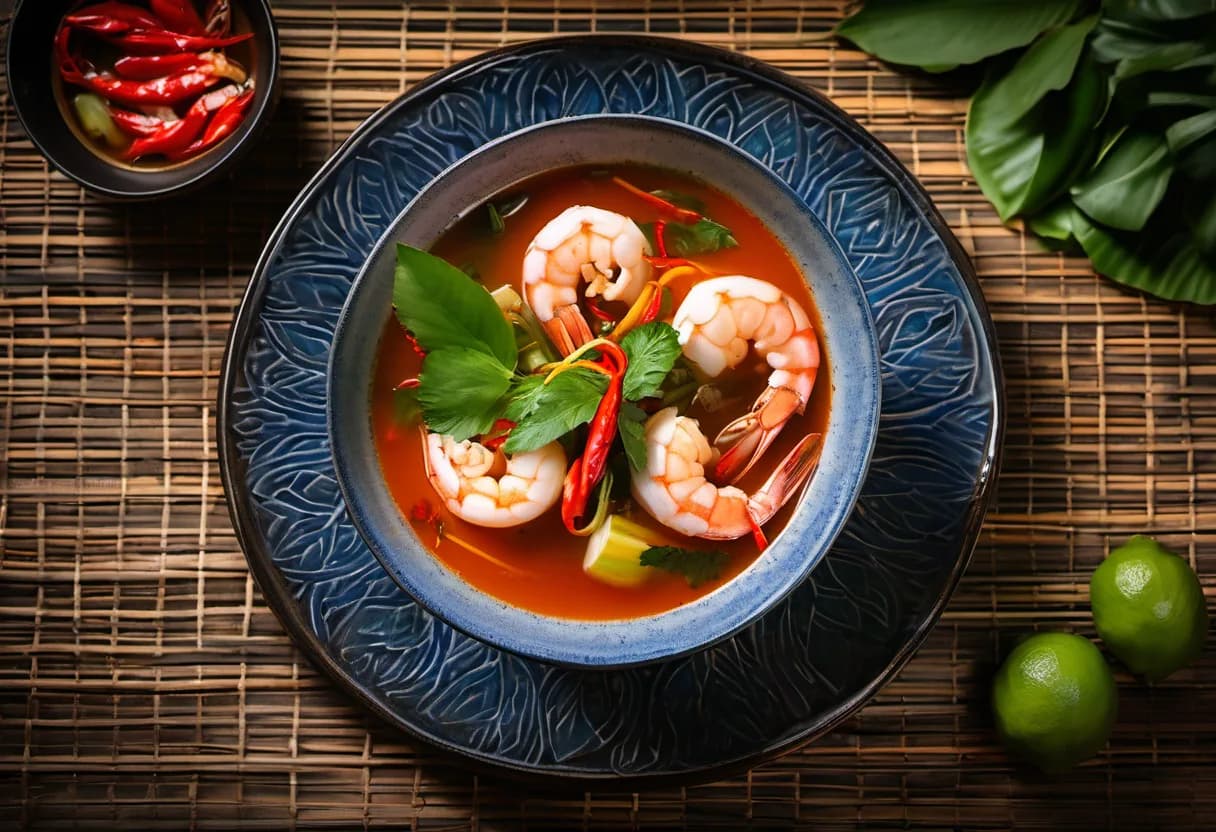
Tom Yum Goong is Thailand's most famous hot and sour prawn soup, perfumed with lemongrass, kaffir lime leaves, and galangal. The broth is intensely aromatic and deeply satisfying.
Cultural Origin
Tom yum goong is a Central Thai hot-and-sour soup whose roots are usually traced to the riverine communities of the Chao Phraya basin, where freshwater prawns were abundant. The sour-spicy profile draws on long-established Thai uses of lemongrass, galangal, kaffir lime leaf and chili, while the creamy nam khon variant — popularised in the 20th century — adds evaporated milk or coconut milk in the post-WWII era. It is now considered one of Thailand's signature dishes and a cornerstone of royal-style Central cuisine.
Regional Variants
| Region | How it differs |
|---|---|
| Central | The Bangkok version, especially nam khon, finishes with evaporated milk and chili paste for a richer, opaque broth. |
| Southern | Southern cooks lean on extra bird's-eye chili and sometimes turmeric, producing a hotter, more pungent clear broth. |
| Isaan | Isaan tom yum is often made with freshwater fish or chicken instead of prawn and uses pla ra for a funkier sourness. |
Allergens & Sensitivities
Key Ingredients
- prawns
- lemongrass
- kaffir lime leaves
- galangal
- fish sauce
Taste profile
- Salty
- fish sauce, soy, shrimp paste
- Sweet
- palm sugar, coconut
- Sour
- lime, tamarind, fermentation
- Umami
- dried shrimp, fermented pastes, stock
The clear broth hits sour first, from lime, then a savoury depth from fish sauce and prawn stock; the herbs are aromatic rather than eaten, and the chilli heat builds rather than front-loads.
How Tom Yum Goong Is Made
- 1
Build the broth
Water or light stock is brought to a simmer with bruised lemongrass, galangal slices and torn kaffir lime leaves to infuse their aroma.
- 2
Add prawns
Prawns go in once the aromatics have infused, simmered just until they turn opaque and firm.
- 3
Add mushrooms and chilli
Straw mushrooms and crushed bird's-eye chillies are added, simmered briefly so the mushrooms soften without overcooking the prawns.
- 4
Season off the heat
Fish sauce and lime juice are stirred in after the pot is removed from the heat, since boiling lime juice dulls its sharpness.
- 5
Finish and serve
The soup is topped with coriander and served immediately, still steaming, in the same pot or a shared bowl.
When It’s Eaten
Ordered as a shared main alongside steamed rice and other dishes, rarely eaten alone; common at both lunch and dinner across every kind of restaurant.
How to Order It
- น้ำใส
- nam sai
- clear broth (not creamy)
- น้ำข้น
- nam khon
- creamy broth
- เผ็ดน้อย
- phet noi
- mild
What people get wrong
Chewing on the lemongrass stalks or galangal slices left in the bowl — they are added purely for aroma and are fibrous enough to be unpleasant if eaten directly.
Where to Try It
Virtually every Thai restaurant offers it — try a riverside restaurant in Bangkok for the full experience.
Tips
- There are two versions: clear broth (nam sai) and creamy coconut milk broth (nam khon) — try both.
- Don't eat the lemongrass stalks or galangal slices — they're aromatics, not meant to be chewed.