Panang Curry
แกงพะแนง
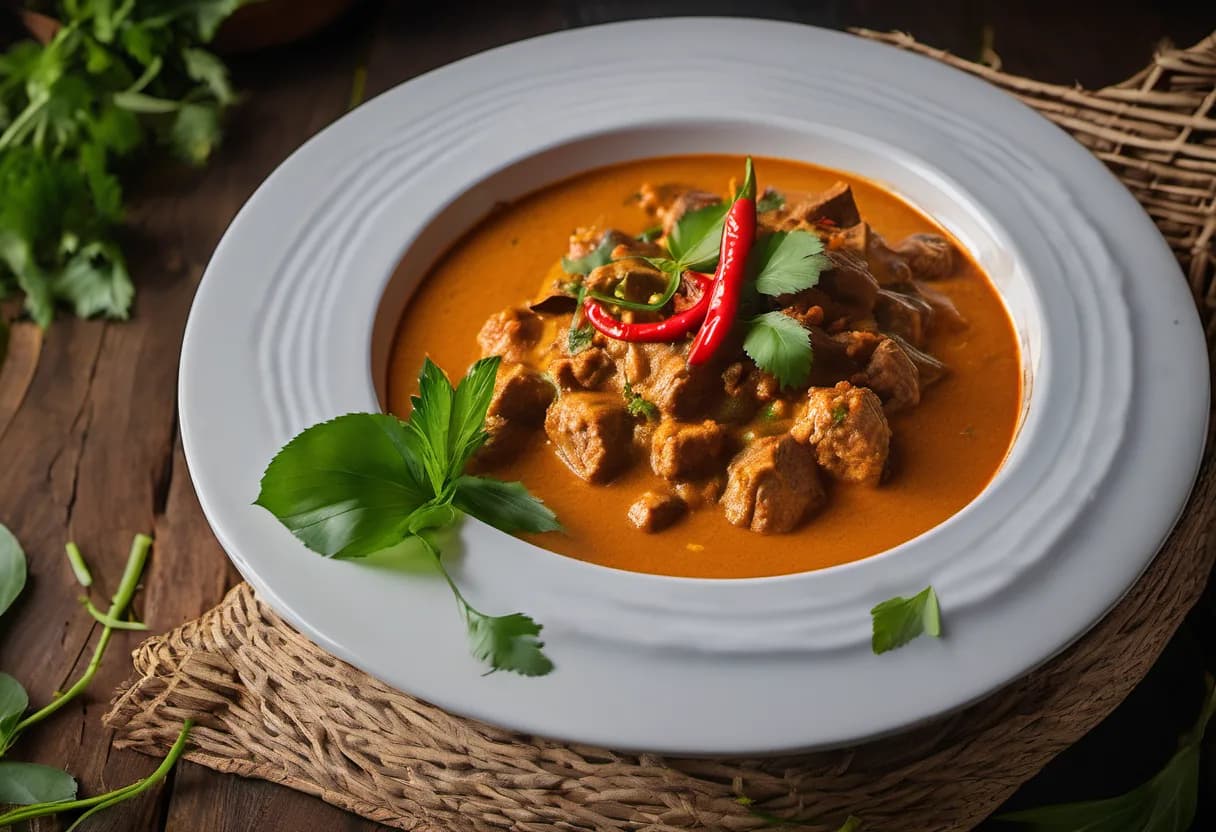
Panang Curry is a thick, dry-style Thai curry with a nutty richness from ground roasted peanuts in the paste. Less soupy than other curries, it clings to the meat with a concentrated, slightly sweet and deeply savoury sauce.
Cultural Origin
Panang (or phanaeng) is a Central Thai curry thicker, sweeter and milder than red or green curry, traditionally finished with a small amount of coconut cream rather than a thin coconut-milk broth. The name is sometimes linked, though disputedly, to Penang island in Malaysia, reflecting historical Thai-Malay trade and culinary exchange. It typically uses peanut in the paste and is served almost dry over beef or chicken, garnished with kaffir lime leaf chiffonade.
Regional Variants
| Region | How it differs |
|---|---|
| Central | The Bangkok standard is thick, sweet and mildly spicy, usually with beef or chicken and a finish of coconut cream and kaffir lime leaf. |
| Southern | Southern Thai-Muslim versions can be drier, spicier and use more dry spices reflecting Malay influence. |
Allergens & Sensitivities
Key Ingredients
- panang curry paste
- coconut cream
- beef or chicken
- kaffir lime leaves
- palm sugar
Taste profile
- Salty
- fish sauce, soy, shrimp paste
- Sweet
- palm sugar, coconut
- Sour
- lime, tamarind, fermentation
- Umami
- dried shrimp, fermented pastes, stock
Ground roasted peanuts thicken the sauce to a paste-like consistency and add a toasted, nutty note absent from other curries; there is little free liquid, so the flavour reads as concentrated rather than brothy.
How Panang Curry Is Made
- 1
Pounding the peanut paste
Panang paste follows the same base as red curry paste — dried chilli, lemongrass, galangal, garlic, shallot — but has roasted peanuts pounded in, which is what gives the finished dish its thickness and nutty depth.
- 2
Reducing the cream alone
Only the thick coconut cream is used, heated until it splits, since Panang is deliberately made without the thin coconut milk that loosens other curries.
- 3
Frying the paste until it darkens
The paste is fried in the cream for longer than for a soupy curry, until it darkens and the oil visibly separates, concentrating the flavour before any protein is added.
- 4
Adding the sliced meat
Beef or chicken, sliced thin, is stirred through the fried paste and simmered gently until the sauce clings to the meat rather than pooling around it.
- 5
Finishing with lime leaf
Palm sugar and fish sauce round out the sweetness and salt, and the dish is topped with finely shredded kaffir lime leaf and sometimes a swirl of extra coconut cream just before serving.
When It’s Eaten
Ordered as a rich, filling main rather than a light lunch, usually with plain rice to offset the concentrated sauce; less commonly eaten as a solo dish given how heavy it is compared with soupier curries.
How to Order It
- ขอแกงพะแนงหนึ่งที่
- kor gaeng panang neung thi
- One Panang curry, please
- ไม่ใส่ถั่ว
- mai sai tua
- No peanuts, please
What people get wrong
Confusing it with Massaman because both are mild, brown-red and nutty — Panang is far thicker and drier, with a stronger toasted-peanut character, whereas Massaman is soupier and spiced with cinnamon and cardamom.
Where to Try It
Most mid-range Thai restaurants — beef Panang is the gold standard version to order.
Tips
- Order beef Panang for the most traditional experience — the slow-cooked beef becomes incredibly tender in the thick sauce.
- The sauce should coat the meat rather than pool like a soup — a good Panang is thick and glossy.