Massaman Curry
มัสมั่น
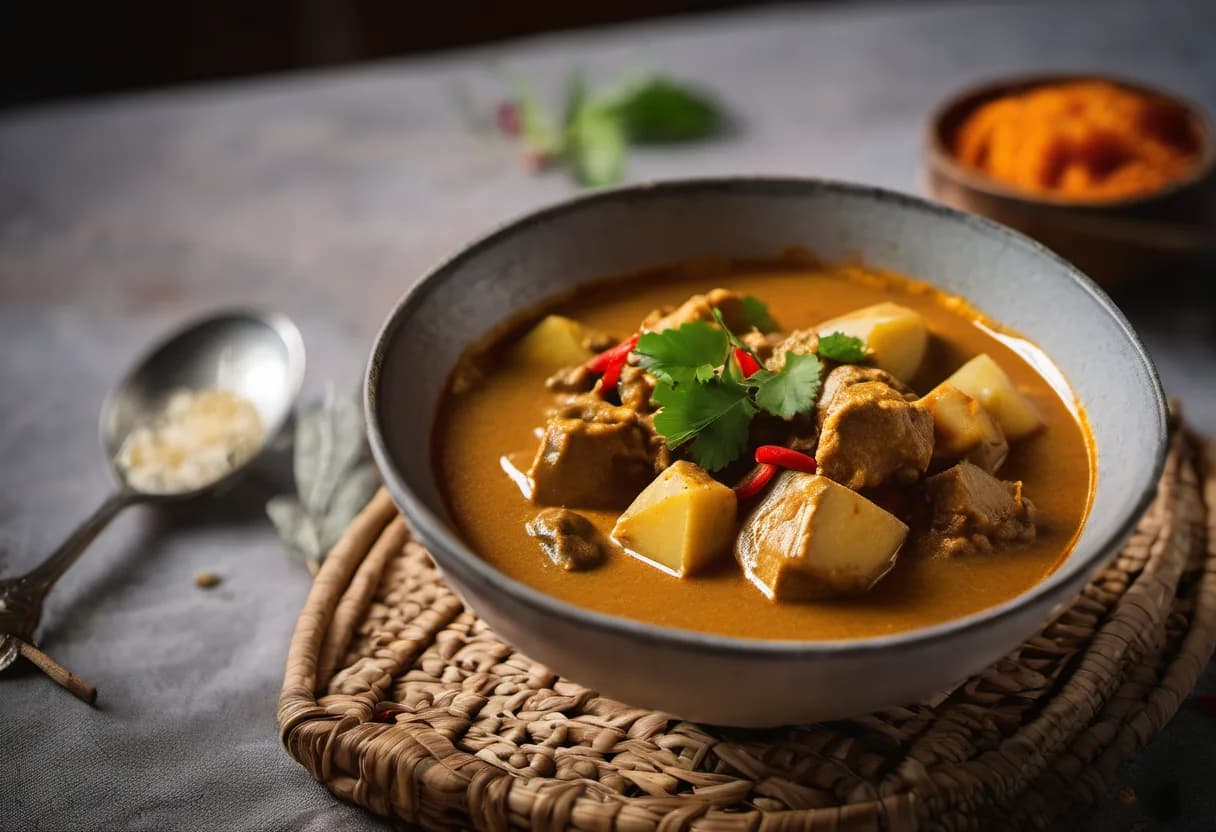
Massaman Curry is Thailand's richest and mildest curry, influenced by Persian and Malay spice trade routes. Slow-cooked with potatoes, onions, and roasted peanuts in a thick coconut milk gravy, it's deeply comforting.
Cultural Origin
Massaman is a Muslim-influenced curry that entered the Thai canon through Persian and Indian merchants trading with the Ayutthaya court in the 17th century, with the name itself derived from a word for Muslim. Its dry spices — cardamom, cinnamon, cloves, cumin, nutmeg — are unusual in Thai cuisine and reflect that foreign origin, while the coconut milk, palm sugar and tamarind are local adaptations. It was historically a royal-court dish in Central Thailand and remains strongly associated with southern Thai-Muslim communities.
Regional Variants
| Region | How it differs |
|---|---|
| Southern | The Thai-Muslim south uses more dry spices, often makes it with goat or beef, and leans drier and richer. |
| Central | The Bangkok royal-style version is sweeter and milder, typically with chicken, potato and roasted peanuts. |
Allergens & Sensitivities
Key Ingredients
- massaman paste
- coconut milk
- potatoes
- roasted peanuts
- cardamom
Taste profile
- Salty
- fish sauce, soy, shrimp paste
- Sweet
- palm sugar, coconut
- Sour
- lime, tamarind, fermentation
- Umami
- dried shrimp, fermented pastes, stock
The dominant aromas are toasted cardamom, cinnamon and cloves rather than chilli; the peanuts add a soft, granular texture and the potato thickens the sauce into something closer to a stew than a curry.
How Massaman Curry Is Made
- 1
Toasting and building the paste
Massaman paste starts like other Thai curry pastes with chilli, lemongrass, galangal and shallot, but adds roasted whole spices — cardamom, cinnamon, cloves, star anise and cumin — toasted and ground in before the fresh ingredients are pounded through.
- 2
Splitting the coconut cream
Coconut cream is simmered on its own until it splits and releases oil, then the paste is fried in it until the spices bloom and the raw-chilli smell disappears.
- 3
Braising the meat
Beef, lamb or chicken is added to the fried paste with the thin coconut milk and left to simmer slowly — traditionally for over an hour with beef or lamb — until it falls apart easily.
- 4
Adding potato and peanuts
Potato, roasted peanuts, tamarind and palm sugar go in partway through the braise so the potato cooks through without disintegrating.
- 5
Resting overnight
Massaman is often made a day ahead and reheated, since the spices continue to infuse the sauce overnight and the flavour is noticeably rounder the next day.
When It’s Eaten
A slow-cooked, special-occasion curry rather than a quick lunch dish — more common at dinner or for guests, and often eaten with roti instead of rice in Muslim-owned eateries.
How to Order It
- ขอมัสมั่นหนึ่งที่
- kor massaman neung thi
- One Massaman curry, please
- มัสมั่นเนื้อ
- massaman neua
- Massaman with beef
What people get wrong
Expecting it to taste like a hot curry because it's called a curry at all — Massaman is built around warm baking spices, not chilli, and ordering it thinking it will have a kick leads to disappointment for spice-seekers.
Where to Try It
Southern Thai restaurants and Muslim-owned eateries in Bangkok's Bang Rak district.
Tips
- Ask for beef or lamb for the most traditional version — the long braising time makes the meat incredibly tender.
- The sauce is perfect for mopping up with roti bread instead of rice.