Kanom Jeen
ขนมจีน
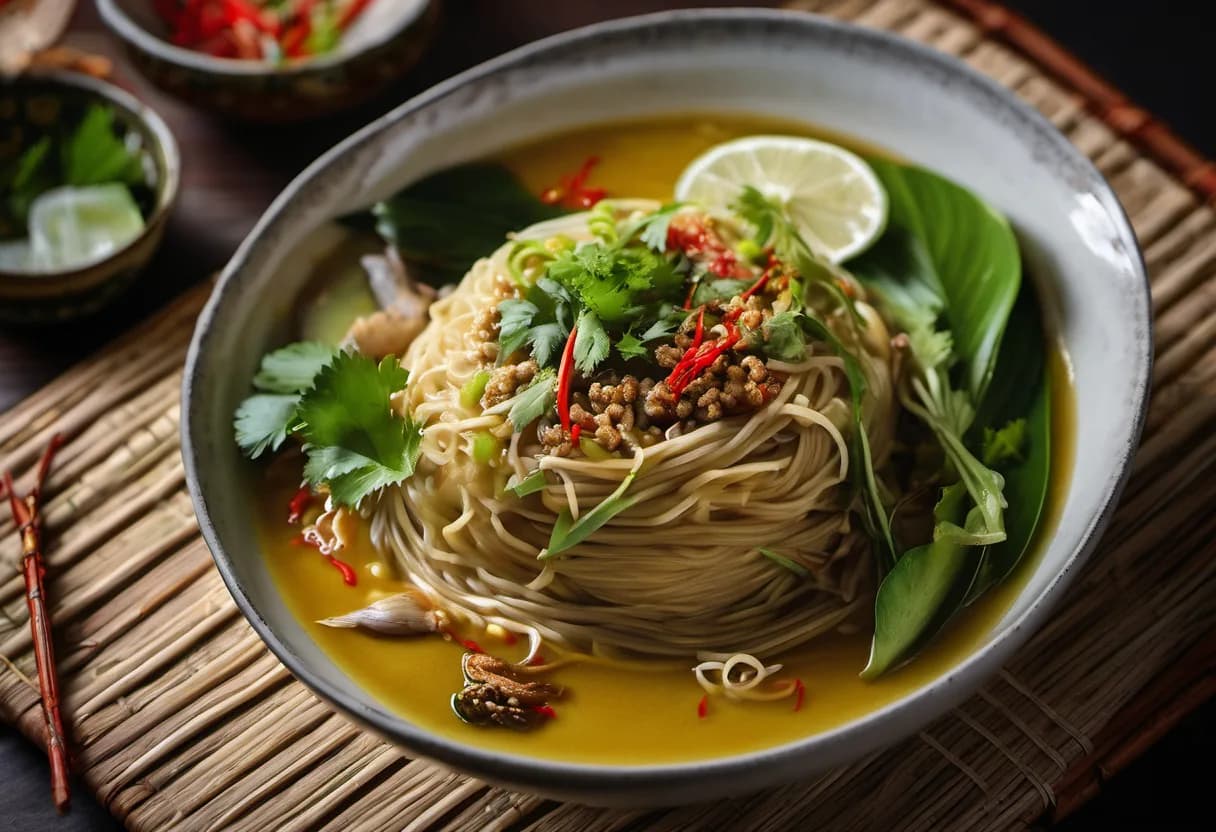
Kanom Jeen are thin, slightly fermented rice noodles served at room temperature with your choice of curries and toppings from a spread of condiments. A communal, flexible dish particularly associated with central and southern Thailand.
Cultural Origin
Kanom jeen are fresh fermented rice noodles whose Mon and Indian-derived technique long predates the Thai kingdom; the name itself is from a Mon word for 'cooked noodles' rather than from Chinese. They are served cold and topped with one of many curries — kanom jeen nam ya (fish curry), nam prik (peanut-fermented soybean), or southern kanom jeen nam ya tai. The dish is found nationwide but is especially central to southern and central Thai festival cooking.
Regional Variants
| Region | How it differs |
|---|---|
| Central | Central kanom jeen nam ya uses a milder fish-and-galangal curry with hard-boiled egg and pickled vegetables. |
| Southern | Southern kanom jeen nam ya tai is much hotter and uses turmeric and southern curry paste with fish. |
| Northern | Northern kanom jeen nam ngiao tops noodles with a pork-and-tomato broth flavoured with dried cotton-tree flower. |
| Isaan | Isaan kanom jeen is often served with a pla ra-based broth and raw vegetables. |
Allergens & Sensitivities
Key Ingredients
- fermented rice noodles
- green curry sauce
- nam ya sauce
- fresh vegetables
- bean sprouts
- pickled vegetables
Taste profile
- Salty
- fish sauce, soy, shrimp paste
- Sweet
- palm sugar, coconut
- Sour
- lime, tamarind, fermentation
- Umami
- dried shrimp, fermented pastes, stock
The noodles themselves carry a mild fermented tang before any curry is added, which is what makes kanom jeen taste distinct even from other rice noodles — the overall flavour then depends heavily on which curry is spooned over, from the mild fish-based nam ya to hotter southern versions.
How Kanom Jeen Is Made
- 1
Fermenting the rice
Rice is soaked and left to ferment for a period before milling, the step responsible for the noodles' faint sourness and what separates kanom jeen from ordinary rice noodles.
- 2
Extrusion
The fermented rice batter is pressed through small holes directly into boiling water, forming thin strands that set almost immediately — a different method from the sheet-cut or dried noodles used elsewhere in Thai cooking.
- 3
Cooling
The cooked strands are rinsed in cool water and coiled into small nests, then served at room temperature rather than hot.
- 4
Curry choice
A curry is ladled over just before eating — commonly a fish-based nam ya, though the choice varies by region and by what a vendor has made that day.
- 5
Condiments
A spread of raw and pickled vegetables, bean sprouts and boiled egg is set out for the diner to add themselves, making the dish as much an assembly as a single fixed recipe.
When It’s Eaten
Primarily a morning dish, sold at markets from dawn until roughly mid-morning; it is also common at temple merit-making meals and festival gatherings rather than being an evening restaurant order.
How to Order It
- ขนมจีน
- kanom jeen
- kanom jeen noodles
- น้ำยา
- nam ya
- fish curry sauce
- ไม่ใส่ไข่ต้ม
- mai sai khai tom
- no boiled egg
What people get wrong
Expecting the noodles to be served hot — kanom jeen is meant to be room temperature, and the contrast between the cool noodles and the hot curry poured over them is intentional rather than a sign the dish arrived lukewarm by accident.
Where to Try It
Fresh markets in the morning, Buddhist temple food offerings, and dedicated kanom jeen restaurants throughout central and southern Thailand.
Tips
- Try with nam ya (fish-based sauce with galangal) — it is the most traditional pairing.
- Add raw vegetables from the condiment spread — morning glory, bean sprouts, and long beans are typical accompaniments.