Green Curry
แกงเขียวหวาน
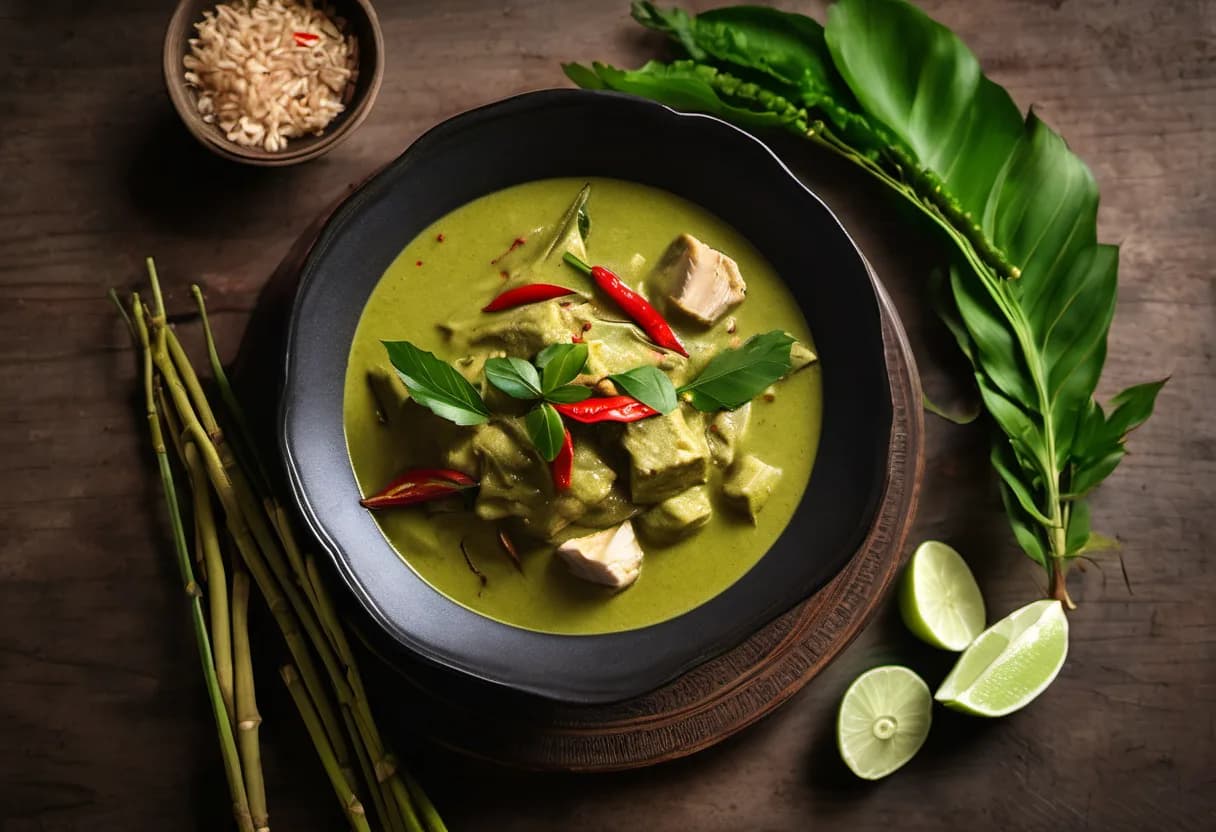
Green Curry (Gaeng Keow Wan) is arguably the most vibrant of Thailand's curries, made with a fresh paste of green chillis, lemongrass, and basil simmered in rich coconut milk. Despite the name, it's not sweet — it's the hottest of the Thai curries.
Cultural Origin
Gaeng keow wan, green curry, emerged in the Central Thai royal kitchens of the early Rattanakosin era (early 1900s), when fresh green bird's-eye chilies were pounded with herbs into a vivid paste. The dish reflects the wider Thai curry tradition, which fuses Indian-derived spice culture with Southeast Asian coconut milk and Thai aromatics. It is now ubiquitous nationwide, but its sweet, creamy register remains rooted in Bangkok and Ayutthaya cooking.
Regional Variants
| Region | How it differs |
|---|---|
| Central | The standard sweet-creamy Bangkok style uses fresh green chilies, sweet basil, Thai eggplant and coconut milk with chicken or fish balls. |
| Southern | Southern versions add more chili and sometimes turmeric, producing a much hotter, slightly yellow-tinged green curry. |
| Northern | Northern cooks often omit or reduce coconut milk and use less sugar, resulting in a thinner, herbier broth. |
Allergens & Sensitivities
Key Ingredients
- green chilli paste
- coconut milk
- chicken or tofu
- Thai basil
- kaffir lime leaves
Taste profile
- Salty
- fish sauce, soy, shrimp paste
- Sweet
- palm sugar, coconut
- Sour
- lime, tamarind, fermentation
- Umami
- dried shrimp, fermented pastes, stock
Fresh green chillies and a fistful of Thai basil at the end give it a sharper, more herbaceous aroma than the other coconut curries; the aftertaste is peppery rather than sweet.
How Green Curry Is Made
- 1
Pounding the green paste
Fresh green bird's-eye chillies are pounded with lemongrass, galangal, garlic, shallot, coriander root and shrimp paste into a smooth, vividly green paste — the fresher the chillies, the greener and hotter the result.
- 2
Cracking the coconut cream
The thick cream that rises to the top of a tin of coconut milk is heated alone first, without water, until the oil separates — this cracking step is what gives a good green curry its glossy sheen and concentrates the paste's aroma when fried in it.
- 3
Frying the paste in the cream
The green paste is fried in the cracked cream until fragrant, several minutes, before the remaining thin coconut milk is added to loosen the sauce to a pourable consistency.
- 4
Adding protein and vegetables
Chicken, beef or tofu goes in first to simmer through, followed by Thai aubergine and pea aubergines, which need only a few minutes to soften without turning mushy.
- 5
Finishing with basil and lime leaf
Fish sauce and palm sugar are added to balance the paste's heat, then kaffir lime leaves and a generous handful of Thai basil are stirred in at the very end so the basil wilts rather than cooks.
When It’s Eaten
Served as one dish among several at a shared Thai meal, always with a mound of jasmine rice rather than eaten alone; it's equally at home as a quick lunch over rice at a street stall.
How to Order It
- ขอแกงเขียวหวานหนึ่งที่
- kor gaeng keow wan neung thi
- One green curry, please
- เผ็ดน้อย
- phet noi
- Mild, please
What people get wrong
Assuming green means mild because of the pale colour — green curry is consistently the hottest of the coconut curries, hotter than red, because fresh chillies carry more capsaicin than the dried ones used elsewhere.
Where to Try It
Order it at any mid-range Thai restaurant — street food versions over rice are excellent value.
Tips
- Thai basil (not Italian basil) is essential — the anise-like flavour is what makes the dish.
- Serve with jasmine rice to soak up the rich, spicy sauce.